Soz e Jigar
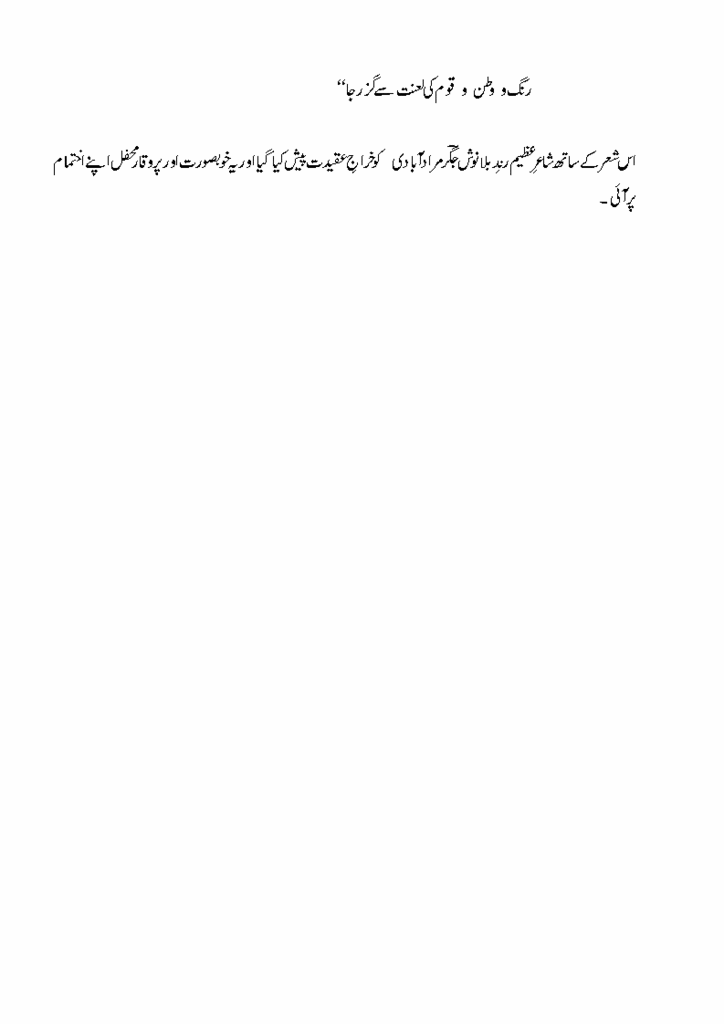
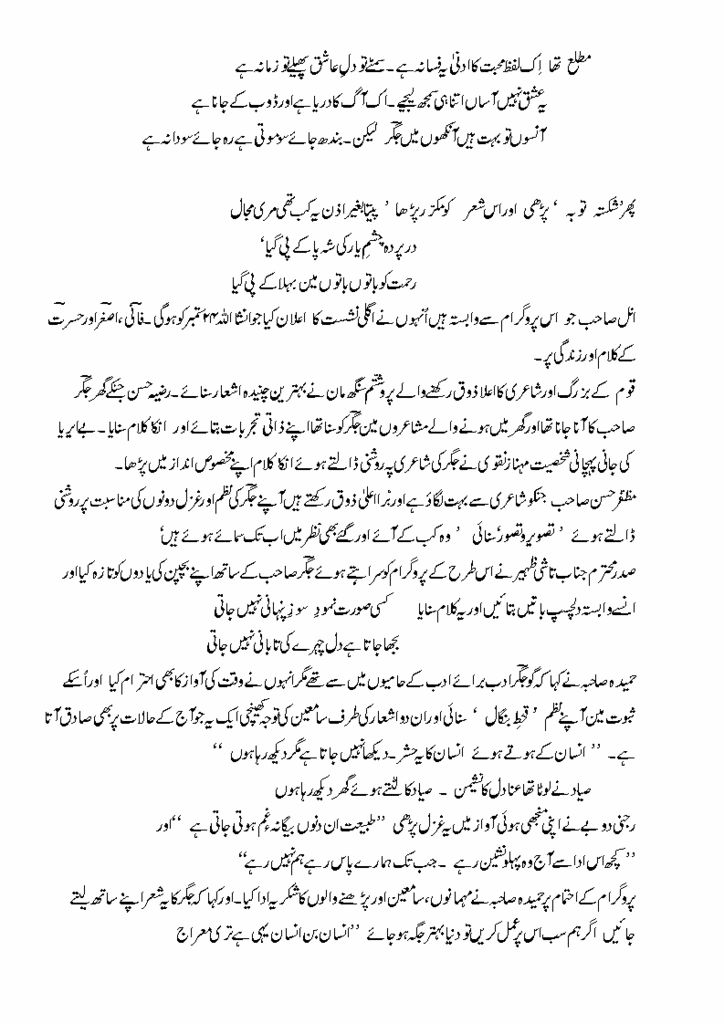
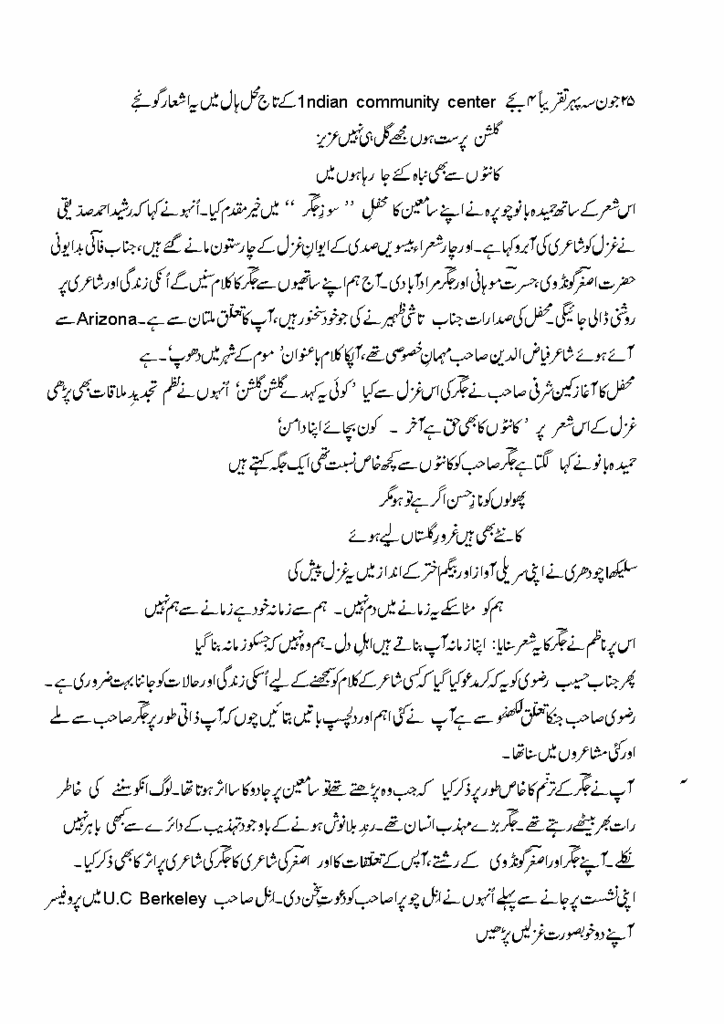
Soz e Jigar, a literary gathering to celebrate the work of great Urdu poet Jigar Muradabadi, was held at the Indian Community Center on June 25, 2005. The program was arranged by Bay Area Urdu teacher Hamida Chopra.
The Urdu report that I just posted on this blog was written by a participant who wants to remain anonymous.
C.
Thursday, July 28, 2005
Wednesday, July 27, 2005
Review of Urdu Adab monthly, from Canada

Just received the June edition of Urdu Adab, an Urdu
literary magazine published in Mississauga, Canada.
Read the whole magazine in one go--well, the prose
part, as I understand prose better than poetry.

First and foremost, the Urdu speaking Diaspora settled
in North America really needed a quality Urdu
magazine.  Kudos to Urdu Adab's editor Munir Saami for
taking the initiative!

The June edition--the first one--is dedicated to Jaun
Elia, the Howard Stern look alike Pakistani poet who
died not too long ago.  I was hoping to find some
biographical information about Jaun; the only write-up
that came somewhat close to being personal was
Peerzada Salman's article, originally published in
Daily Dawn.

"Afsanay kee naee aawazain" by Asif Farrukhi is a good
read but it does not provide the kind of information
one hopes to find in an article of that title.
Farrukhi gives us, in the last third of his narrative,
names of only five new Urdu short story writers!  Only
five!

"Allama Iqbal, aik mehbooba, teen beeviyan, char
shadiyan" by Dr. Khalid Sohail is the kind of articles
I love to read more of.  Excellent research!

Short stories presented in the June edition of Urdu
Adab:

Karamat Ghouri's "Safr e Na-Tamam" seems more like a
true story--a story that the writer heard in one of
his travels and found it worthwhile to beautifully
transform into an Urdu afsana.

Rahim Unjan's "Do Monhi" provides a representative
sample of that genre of Pakistani nationalist
literature that feeds on its own venom.  This is the
kind of literature that makes sure that the animosity
between the peoples of India and Pakistan is kept
alive.

Abid Jafri's "Koi aur hoga" is a creation of a very
sensitive mind.  It is the story of our time when we
hear of the bombs dropped on people like you and I,
when we hear of blasts killing sons and daughters of
people like you and I--but we seldom come out of our
apathy to raise a voice of resistance.  And one day
when the misfortune falls on us we complain of others'
indifference.
An alternate title of Abid Jafri's story can be "Giree
hai jis peh kul bijlee."

The price of the Urdu Adab magazine is not indicated
anywhere but its austere look--the magazine is printed
on scrub paper--gives confidence that the production
team understands the economic realities and that it
won't let its efforts go financially bust after a few
publications.  [Many like myself must be willing to
pay the subscription.]

Well done, Urdu Adab team!
Tuesday, July 12, 2005

Wednesday, July 06, 2005
Fireworks at the Central Park at 9:30 p.m.
Everybody was walking in one direction. We just followed the people who were ahead of us. I am sure the ones behind us were following us. Somebody up there, all the way up there, must have known where to go. Novice fireworks watchers were still in their cars, making rounds of the block to find a parking place. The most convenient parking places were already taken—long time ago.
We reached the park and stood at the periphery of a very large human circle. We waited with everybody else. People hate to be quiet; they just keep talking. There were a lot of people around us but no one spoke English. You could hear Pilipino, Spanish, Tamil, Punjabi, Bosnian, but no English. Well, I should not say 'no English'; you could occasionally hear a child say something in English, but then the parents would respond back in their native tongue.
I like watching fireworks. I try to lose the sight of people around me, or of the trees reaching out in the sky. People and trees remind me of my surroundings. I want to be totally absorbed in the magic of the fireworks and don't want to be reminded of the real world. Fireworks are so wonderful! A little ball shoots up in the sky; it bursts and there comes a shower of sparkling stars. It is like life itself, ephemeral and full of energy.
At the end of the show they just let out a volley of the crackers. There were so many of them, so much going on you could not concentrate on one part of the sky, you just had to look at the entirety of the show and absorb the general impression. The sky was truly lit by the fireworks. My eyes welled with tears. This is what independence truly means. This is what being free is all about. The recognition of independence should fill you up with joy. Forget about the toil of tomorrow; forget about the worries of your distant future; enjoy today, now, this very moment when the sky is being decorated with fireworks, for you.
I wondered how many people were behind the show--I mean the workers. Must not have been too many. So few people, giving happiness, providing entertainment to so many! I also thought about the many faces of a state--spectacular decorative fireworks for the amusement of some, menacing fireworks in foreign lands for the punishment of the others.
Everybody was walking in one direction. We just followed the people who were ahead of us. I am sure the ones behind us were following us. Somebody up there, all the way up there, must have known where to go. Novice fireworks watchers were still in their cars, making rounds of the block to find a parking place. The most convenient parking places were already taken—long time ago.
We reached the park and stood at the periphery of a very large human circle. We waited with everybody else. People hate to be quiet; they just keep talking. There were a lot of people around us but no one spoke English. You could hear Pilipino, Spanish, Tamil, Punjabi, Bosnian, but no English. Well, I should not say 'no English'; you could occasionally hear a child say something in English, but then the parents would respond back in their native tongue.
I like watching fireworks. I try to lose the sight of people around me, or of the trees reaching out in the sky. People and trees remind me of my surroundings. I want to be totally absorbed in the magic of the fireworks and don't want to be reminded of the real world. Fireworks are so wonderful! A little ball shoots up in the sky; it bursts and there comes a shower of sparkling stars. It is like life itself, ephemeral and full of energy.
At the end of the show they just let out a volley of the crackers. There were so many of them, so much going on you could not concentrate on one part of the sky, you just had to look at the entirety of the show and absorb the general impression. The sky was truly lit by the fireworks. My eyes welled with tears. This is what independence truly means. This is what being free is all about. The recognition of independence should fill you up with joy. Forget about the toil of tomorrow; forget about the worries of your distant future; enjoy today, now, this very moment when the sky is being decorated with fireworks, for you.
I wondered how many people were behind the show--I mean the workers. Must not have been too many. So few people, giving happiness, providing entertainment to so many! I also thought about the many faces of a state--spectacular decorative fireworks for the amusement of some, menacing fireworks in foreign lands for the punishment of the others.
Wednesday, June 08, 2005
Tuesday, May 24, 2005
Dinner by the Asian American Journalist Association (AAJA) on May 22, 2005
It is 4 p.m. and I can't decide if I should drive to San Francisco, take BART, or take Caltrain. I know that BART is more frequent, but I would have to drive all the way to Fremont to catch it. I look for BART schedule on the net--the train leaves Fremont every 20 minutes, and to go to the Embarcadero station I would have to change trains at Bay Fair. While I am making decisions about my commute my clothes are going through laundry. I look at the clock, it is 4:20; the dryer will run till 4:45; let me quickly take a shower, get ready, take the clothes out of the dryer, and then head to the Fremont BART station. I won't be able to catch the 5:12 train, but the 5:32 one looks more doable. I go through the program. It is 5:02 when I get in the car, but then another setback: I am out of gas. I stop at the neighborhood gas station; first thinking of buying enough gas to just make it to the Fremont station, but then deciding on filling up the tank--heck I am already late for the 5:32 train. MapQuest says it will take 28 minutes to drive to the Fremont station. While driving I wonder if MapQuest calculates driving times for really slow drivers, if I will be able to make it there in 15 minutes, just in time to catch the 5:32 train. Traffic slows down near the Dixon Landing exit on 880. I am not looking at the clock anymore. MapQuest told me to turn right on Mowry, then right on the Civic Center Drive, and then left on BART way. I keep driving on Mowry, but I don't find the Civic Center Drive. I wonder if I have missed it. I make a right turn at a signal to see if going down that way I will come across BART way. I stop at the next light. The car on my left has its window down. I ask the driver about the BART station. He tells me to go back to Mowry and keep driving in the direction I was driving; Civic Center Drive will be after Paseo Padre. I do what he told me. This being Sunday, there is plenty of parking available at the station. I walk to the station building and for the next couple of minutes fight with the ticket machine. It is not accepting my credit card. I feed dollar bills in the machine, it spits my $4.70 ticket to Embarcadero. There is a train at the station; I get in and take a seat. It is now 5:42. There is an announcement that the doors are about to close. Hooray! It is the 5:32 train running 10 minutes late, I tell myself. The doors close, but seconds later open back. My joy is short lived. It is the 5:52 train; the driver was just playing with the doors, and me. I hate her. The train leaves on time. The car I am sitting in is mostly empty. The commuter trains have their own unique culture. All the passengers sit very quietly, either reading something or looking out of the window. They are all aware of each other's presence but they pretend otherwise. And then there is always this instance when the doors joining your car to the other car open, a man enters, walks across, and leaves at the other end. Everybody checks him out and forms their own opinion about him.
Two stations later three young girls board our car and liven up the atmosphere. That's another organic part of the commuter train culture: young, good looking women will board the train and everybody will become interested in them. These three girls are talking rather loudly and all of us while pretending we are not paying any attention are keenly interested in their conversation. The girl wearing a black T-shirt bends to get something out of her bag. Her top lifts up and bares the lower portion of her back. You can see she is wearing a red underwear, a thong. It is taking her a while to find what she is looking for--nobody minds the delay. Take your time, Honey! But then she sits up and the show is over.
I get off at Bay Fair. There is a little wait at that station. During that time two trains carrying passengers unknown to me, living lives of complexities unrecognized by me, pass by.
By the time I reach Embercadero it is 6:42. I walk to 101 Spear Street. The dinner is at Yank Sing Restaurant. There are a bunch of people outside the restaurant; all dressed up, putting on their best behavior, enjoying drinks, talking passionately. I look for a registration table, there is none. I walk into the restaurant. It is full. Tables are numbered. I look for a table with all the South Asian journalists sitting at it; I don't find one. I am now looking for Julie Patel of San Jose Mercury News; I am here on her invitation. I find Julie at the far end of the room. I am glad I recognize her even when she is in a sari today--our last meeting took place many months ago. Julie tells me she wasn't sure I was coming, someone else has taken the seat at the table I was going to sit at. She says I can sit at the table we are standing it; there are two seats available there. I take a seat and get introduced to the people at that table. They are Jane Morrison of San Francisco Democratic County Central Committee, Gimmy Park Li of Susquehanna, Boyd Fung of Hong Kong Economic and Trade Office, Brenda Huang of Tracy Press, and Audrey Wong and Judith Sagami of Daily Republic. We talk about little things newly introduced people talk about. Jane tells me she is originally from Oklahoma and came to California in 1949. I wonder if that year California had a centennial celebration of the gold rush. I ask if being so late I have missed anything. Jane tells me I missed the Filipino dance. Brenda tells me the name of that dance, a name that slips off my mind very quickly. I'll Google it.
Then the speeches start. I am sitting behind a massive pillar. To see the speaker I have to turn my chair around and pull out a bit. It is an awkward position. Just then Julie shows up; she tells me there are seats at Table #18, in case I want to move. I mumble my excuse to the people at the table and head to #18. After I leave I wonder if my table-mates thought it was rude of me to leave like that. I am sorry, but don't know how to convey my sorry to them.
Table #18 is more centrally located. I can see the podium and the speakers. I get introduced to some of the people at that table. They are Virginia Mak of HP, Edward Iwata of USA Today, and Kai Aiyetoro of the National Federation of Community Broadcasters.
Speeches are made by important people while we carry on with our dinner. I feel very ignorant because I don't know any of the speakers--well, I know Lisa Chung of the Mercury News. The cliché of that night's speeches is civil rights: Asian Americans representation in media, diversity in Hollywood, same sex marriages, and all.
Yank Sing is famous for its many course dinner--this will be my first time to go beyond a 3-course affair (salad/soup, entree, and dessert). Multiple course dinner appropriately comes with smaller serving plates--you are supposed to take just a bit from every course. Salad and soup are followed by shrimp cocktail, then fish, then vegetables, then chicken, then I don't remember what. The business ends with rice. People are now getting up. Everyone has overeaten. A waiter comes and asks if any of us would like to pack anything to take home. We all ponder the merits and demerits of that proposition. Kai braves out; she tells the waiter she would like to have the remainder of the shrimp dish packed. I follow suit and ask for the leftover rice and fish.
The waiter comes back after a few minutes; he got two bags in his hand. I am given the big red plastic bag--the rice and fish are in there in a foam box; Kai gets the small paper bag. Kai comments on why she didn't get her paper bag in a bigger plastic bag like mine. I ask the waiter to get a plastic bag for Kai. He says they don't have anymore plastic bags. I don't know what to think of this. Kai says something to the young woman sitting next to her. I can't hear her but I wonder if Kai is commenting on this incidence to be some kind of discrimination. Was it sexism? That I being a man was treated better than a woman (Kai), or was it some kind of racism in which Asian Americans are provided better service than the Afro Americans?
I say goodbye to Kai and others and leave. I go back to the table I sat at earlier. Boyd, Brenda, and others are still there. I take leave from them and promise I will get in touch with them via email.
I now look for Julie; I want to talk to her before leaving. Julie is one of the organizers of today's program. Tonight she is a social butterfly gliding from one corner of the room to the other, giving smiles, saying hi to everyone she knows, which is basically everyone in the hall. I meet her and briefly speak to her. I tell her I need to send her my check for the dinner. She asks if I have my checkbook with me. I don't. I had this mental note that I would tear off one check from the checkbook and take it with me to the dinner. But then in the rush of things I completely forgot.
It is a little after 9 p.m. as I come out of the restaurant. The Spear Street is deserted. I walk towards the BART station; far behind me a homeless person yells something and I fight the urge to look back. The BART station is full of life. I am able to use my ATM card at the ticket machine. I now realize that at the Fremont station I was inserting my credit card backwards; that's why the machine failed to read it.
Sitting in the train I pull out a blank piece of paper. I have to become one with the commuter train culture. I must be absorbed in doing something. I start writing notes on today's program.
It is 4 p.m. and I can't decide if I should drive to San Francisco, take BART, or take Caltrain. I know that BART is more frequent, but I would have to drive all the way to Fremont to catch it. I look for BART schedule on the net--the train leaves Fremont every 20 minutes, and to go to the Embarcadero station I would have to change trains at Bay Fair. While I am making decisions about my commute my clothes are going through laundry. I look at the clock, it is 4:20; the dryer will run till 4:45; let me quickly take a shower, get ready, take the clothes out of the dryer, and then head to the Fremont BART station. I won't be able to catch the 5:12 train, but the 5:32 one looks more doable. I go through the program. It is 5:02 when I get in the car, but then another setback: I am out of gas. I stop at the neighborhood gas station; first thinking of buying enough gas to just make it to the Fremont station, but then deciding on filling up the tank--heck I am already late for the 5:32 train. MapQuest says it will take 28 minutes to drive to the Fremont station. While driving I wonder if MapQuest calculates driving times for really slow drivers, if I will be able to make it there in 15 minutes, just in time to catch the 5:32 train. Traffic slows down near the Dixon Landing exit on 880. I am not looking at the clock anymore. MapQuest told me to turn right on Mowry, then right on the Civic Center Drive, and then left on BART way. I keep driving on Mowry, but I don't find the Civic Center Drive. I wonder if I have missed it. I make a right turn at a signal to see if going down that way I will come across BART way. I stop at the next light. The car on my left has its window down. I ask the driver about the BART station. He tells me to go back to Mowry and keep driving in the direction I was driving; Civic Center Drive will be after Paseo Padre. I do what he told me. This being Sunday, there is plenty of parking available at the station. I walk to the station building and for the next couple of minutes fight with the ticket machine. It is not accepting my credit card. I feed dollar bills in the machine, it spits my $4.70 ticket to Embarcadero. There is a train at the station; I get in and take a seat. It is now 5:42. There is an announcement that the doors are about to close. Hooray! It is the 5:32 train running 10 minutes late, I tell myself. The doors close, but seconds later open back. My joy is short lived. It is the 5:52 train; the driver was just playing with the doors, and me. I hate her. The train leaves on time. The car I am sitting in is mostly empty. The commuter trains have their own unique culture. All the passengers sit very quietly, either reading something or looking out of the window. They are all aware of each other's presence but they pretend otherwise. And then there is always this instance when the doors joining your car to the other car open, a man enters, walks across, and leaves at the other end. Everybody checks him out and forms their own opinion about him.
Two stations later three young girls board our car and liven up the atmosphere. That's another organic part of the commuter train culture: young, good looking women will board the train and everybody will become interested in them. These three girls are talking rather loudly and all of us while pretending we are not paying any attention are keenly interested in their conversation. The girl wearing a black T-shirt bends to get something out of her bag. Her top lifts up and bares the lower portion of her back. You can see she is wearing a red underwear, a thong. It is taking her a while to find what she is looking for--nobody minds the delay. Take your time, Honey! But then she sits up and the show is over.
I get off at Bay Fair. There is a little wait at that station. During that time two trains carrying passengers unknown to me, living lives of complexities unrecognized by me, pass by.
By the time I reach Embercadero it is 6:42. I walk to 101 Spear Street. The dinner is at Yank Sing Restaurant. There are a bunch of people outside the restaurant; all dressed up, putting on their best behavior, enjoying drinks, talking passionately. I look for a registration table, there is none. I walk into the restaurant. It is full. Tables are numbered. I look for a table with all the South Asian journalists sitting at it; I don't find one. I am now looking for Julie Patel of San Jose Mercury News; I am here on her invitation. I find Julie at the far end of the room. I am glad I recognize her even when she is in a sari today--our last meeting took place many months ago. Julie tells me she wasn't sure I was coming, someone else has taken the seat at the table I was going to sit at. She says I can sit at the table we are standing it; there are two seats available there. I take a seat and get introduced to the people at that table. They are Jane Morrison of San Francisco Democratic County Central Committee, Gimmy Park Li of Susquehanna, Boyd Fung of Hong Kong Economic and Trade Office, Brenda Huang of Tracy Press, and Audrey Wong and Judith Sagami of Daily Republic. We talk about little things newly introduced people talk about. Jane tells me she is originally from Oklahoma and came to California in 1949. I wonder if that year California had a centennial celebration of the gold rush. I ask if being so late I have missed anything. Jane tells me I missed the Filipino dance. Brenda tells me the name of that dance, a name that slips off my mind very quickly. I'll Google it.
Then the speeches start. I am sitting behind a massive pillar. To see the speaker I have to turn my chair around and pull out a bit. It is an awkward position. Just then Julie shows up; she tells me there are seats at Table #18, in case I want to move. I mumble my excuse to the people at the table and head to #18. After I leave I wonder if my table-mates thought it was rude of me to leave like that. I am sorry, but don't know how to convey my sorry to them.
Table #18 is more centrally located. I can see the podium and the speakers. I get introduced to some of the people at that table. They are Virginia Mak of HP, Edward Iwata of USA Today, and Kai Aiyetoro of the National Federation of Community Broadcasters.
Speeches are made by important people while we carry on with our dinner. I feel very ignorant because I don't know any of the speakers--well, I know Lisa Chung of the Mercury News. The cliché of that night's speeches is civil rights: Asian Americans representation in media, diversity in Hollywood, same sex marriages, and all.
Yank Sing is famous for its many course dinner--this will be my first time to go beyond a 3-course affair (salad/soup, entree, and dessert). Multiple course dinner appropriately comes with smaller serving plates--you are supposed to take just a bit from every course. Salad and soup are followed by shrimp cocktail, then fish, then vegetables, then chicken, then I don't remember what. The business ends with rice. People are now getting up. Everyone has overeaten. A waiter comes and asks if any of us would like to pack anything to take home. We all ponder the merits and demerits of that proposition. Kai braves out; she tells the waiter she would like to have the remainder of the shrimp dish packed. I follow suit and ask for the leftover rice and fish.
The waiter comes back after a few minutes; he got two bags in his hand. I am given the big red plastic bag--the rice and fish are in there in a foam box; Kai gets the small paper bag. Kai comments on why she didn't get her paper bag in a bigger plastic bag like mine. I ask the waiter to get a plastic bag for Kai. He says they don't have anymore plastic bags. I don't know what to think of this. Kai says something to the young woman sitting next to her. I can't hear her but I wonder if Kai is commenting on this incidence to be some kind of discrimination. Was it sexism? That I being a man was treated better than a woman (Kai), or was it some kind of racism in which Asian Americans are provided better service than the Afro Americans?
I say goodbye to Kai and others and leave. I go back to the table I sat at earlier. Boyd, Brenda, and others are still there. I take leave from them and promise I will get in touch with them via email.
I now look for Julie; I want to talk to her before leaving. Julie is one of the organizers of today's program. Tonight she is a social butterfly gliding from one corner of the room to the other, giving smiles, saying hi to everyone she knows, which is basically everyone in the hall. I meet her and briefly speak to her. I tell her I need to send her my check for the dinner. She asks if I have my checkbook with me. I don't. I had this mental note that I would tear off one check from the checkbook and take it with me to the dinner. But then in the rush of things I completely forgot.
It is a little after 9 p.m. as I come out of the restaurant. The Spear Street is deserted. I walk towards the BART station; far behind me a homeless person yells something and I fight the urge to look back. The BART station is full of life. I am able to use my ATM card at the ticket machine. I now realize that at the Fremont station I was inserting my credit card backwards; that's why the machine failed to read it.
Sitting in the train I pull out a blank piece of paper. I have to become one with the commuter train culture. I must be absorbed in doing something. I start writing notes on today's program.
Subscribe to:
Posts (Atom)
