Starting a Green Literary tradition
Now there is a Green Halqa-e-Arbab- e-Zauq--not green
as in 'green with envy', but green as in kind to our
environment. This Halqa-e-Arbab- e-Zauq, with Dr.
Khawaja Ashraf as its patron, meets on a conference
call. No need to drive to anywhere or make special
arrangements to fit the Halqa program in your busy
schedule; just call in and be part of the literary
conversation. Green Halqa-e-Arbab- e-Zauq's first
meeting took place on Sunday, July 1. Ijaz Syed,
Shahab Riazi, Saqib Mausoof, Khawaja Ashraf, and this
scribe attended the conference. Ijaz Syed read parts
of a Punjabi translation of his short story "Butt
Sahib" (originally written in English). The story,
translated into Punjabi by Narinder Jeet Kaur, has
appeared in Sanjh, APNA's Quarterly Magazine. A
detailed discussion on the story followed the reading.
Green Halqa-e-Arbab- e-Zauq plans to have regular
meetings on Sundays at 10 am, Pacific Standard Time.
Conference call number and access code would be
published at various forums, before each meeting.
Sunday, June 17, 2007
Hugo Chávez and the closing down of RCTV
Richard Gott appears to be the apologist of the kind that permeates the left today. To these people Chavez is an infallible hero because of the simple fact that he challenges the hegemony of the West. No further questions need to be asked. Chavez is above any independent scrutiny, a very convoluted left logic professes.
Such blind loyalty to a living person appearing to be a revolutionary is pathetic--it paves way for fascism.
----------------
> >>
> >> Racism and TV in Venezuela
> >> by Richard Gott
> >>
> >> "RCTV was a white supremacist channel."
> >>
> >> This article originally appeared in The Guardian
> (UK).
> >>
> >>
> >> After 10 days of rival protests in the streets of
> >> Caracas, memories have been revived of earlier
> >> attempts to overthrow the Bolivarian revolution
> of
> >> Hugo Chávez, now in its ninth year. Street
> >> demonstrations, culminating in an attempted coup
> in
> >> 2002 and a prolonged lock-out at the national oil
> >> industry, once seemed the last resort of an
> opposition
> >> unable to make headway at the polls. Yet the
> current
> >> unrest is a feeble echo of those tumultuous
> events,
> >> and the political struggle takes place on a
> smaller
> >> canvas. Today's battle is for the hearts and
> minds of
> >> a younger generation confused by the upheavals of
> an
> >> uncharted revolutionary process.
> >>
> >> University students from privileged backgrounds
> have
> >> been pitched against newly enfranchised young
> people
> >> from the impoverished shantytowns, beneficiaries
> of
> >> the increased oil royalties spent on higher
> education
> >> projects for the poor. These separate groups
> never
> >> meet, but both sides occupy their familiar
> >> battleground within the city, one in the leafy
> squares
> >> of eastern Caracas, the other in the narrow and
> >> teeming streets in the west. This symbolic battle
> will
> >> become ever more familiar in Latin America in the
> >> years ahead: rich against poor, white against
> brown
> >> and black, immigrant settlers against indigenous
> >> peoples, privileged minorities against the great
> mass
> >> of the population. History may have come to an
> end in
> >> other parts of the world, but in this continent
> >> historical processes are in full flood.
> >>
> >> Ostensibly the argument is about the media, and
> the
> >> government's decision not to renew the
> broadcasting
> >> license of a prominent station, Radio Caracas
> >> Television (RCTV), and to hand its frequencies to
> a
> >> newly established state channel. What are the
> rights
> >> of commercial television channels? What are the
> >> responsibilities of those funded by the state?
> Where
> >> should the balance between them lie? Academic
> >> questions in Europe and the US, the debate in
> Latin
> >> America is loud and impassioned. Here there is
> little
> >> tradition of public broadcasting, and commercial
> >> stations often received their license in the days
> of
> >> military rule.
> >>
> >> "Those most in view on the screen were
> long-haired and
> >> pulchritudinous young blonds."
> >>
> >> The debate in Venezuela has less to do with the
> >> alleged absence of freedom of expression than
> with a
> >> perennially tricky issue locally referred to as
> >> "exclusion", a shorthand term for "race" and
> "racism".
> >> RCTV was not just a politically reactionary
> >> organization which supported the 2002 coup
> attempt
> >> against a democratically elected government - it
> was
> >> also a white supremacist channel. Its staff and
> >> presenters, in a country largely of black and
> >> indigenous descent, were uniformly white, as were
> the
> >> protagonists of its soap operas and the
> advertisements
> >> it carried. It was "colonial" television,
> reflecting
> >> the desires and ambitions of an external power.
> >>
> >> At the final, close-down party of RCTV last
> month,
> >> those most in view on the screen were long-haired
> and
> >> pulchritudinous young blondes. Such images make
> for
> >> excellent television watching by European and
> North
> >> American males, and these languorous blondes are
> >> indeed familiar figures from the Miss World and
> Miss
> >> Universe competitions in which the children of
> recent
> >> immigrants from Europe are invariably Venezuela's
> >> chief contenders. Yet their ubiquity on the
> screen
> >> prevented the channel from presenting a mirror to
> the
> >> society that it sought to serve or to entertain.
> To
> >> watch a Venezuelan commercial station (and
> several
> >> still survive) is to imagine that you have been
> >> transported to the US. Everything is based on a
> >> modern, urban and industrialized society, remote
> from
> >> the experience of most Venezuelans. Their
> programs,
> >> argues Aristóbulo Istúriz, until recently
> Chávez's
> >> minister of education (and an Afro-Venezuelan),
> >> encourage racism, discrimination and exclusion.
> >>
> >> The new state-funded channels (and there are
> several
> >> of them too, plus innumerable community radio
> >> stations) are doing something completely
> different,
> >> and unusual in the competitive world of
> commercial
> >> television. Their programs look as though they
> are
> >> taking place in Venezuela, and they display the
> >> cross-section of the population to be seen on
> >> cross-country buses or on the Caracas metro. As
> in
> >> every country in the world, not everyone in
> Venezuela
> >> is a natural beauty. Many are old, ugly and fat.
> Today
> >> they are given a voice and a face on the
> television
> >> channels of the state. Many are deaf or hard of
> >> hearing. Now they have sign language
> interpretation on
> >> every prograe. Many are inarticulate peasants.
> They
> >> too have their moment on the screen. Their
> immediate
> >> and dangerous struggle for land is not just being
> >> observed by a documentary film-maker from the
> city.
> >> They are being taught to make the films
> themselves.
> >>
> >> "Venezuelan state TV will become a useful space
> for
> >> rescuing those values that other models of
> television
> >> always ignore, especially our Afro-heritage."
> >>
> >> Blanca Eekhout, the head of Vive TV, the
> government's
> >> cultural channel, launched two years ago, coined
> the
> >> slogan "Don't watch television, make it". Classes
> in
> >> film-making have been set up all over the
> country. Lil
> >> Rodríguez, an Afro-Venezuelan journalist and the
> boss
> >> of TVES, the channel that replaces RCTV, claims
> that
> >> it will become "a useful space for rescuing those
> >> values that other models of television always
> ignore,
> >> especially our Afro-heritage". With time, the
> excluded
> >> will find a voice within the mainstream.
> >>
> >> Little of this is under discussion in the
> dialogue of
> >> the deaf on the streets of Caracas. For the
> protesting
> >> university students, the argument about the media
> is
> >> just one more stick with which to hit out against
> the
> >> ever-popular Chávez. Yet as they mourn the loss
> of
> >> their favourite soap operas, they are already
> aware
> >> that their eventual loss may be more substantial.
> As
> >> children of the oligarchy, they might have
> expected
> >> soon to run the country. Now fresh faces are
> emerging
> >> from the shantytowns to challenge them, a new
> class
> >> educating itself at speed and planning to seize
> their
> >> birthright.
> >>
> >> Just a few weeks ago, Chávez outlined his plans
> for
> >> university reform, encouraging wider access and
> the
> >> development of a different curriculum. New
> colleges
> >> and technical institutes across the country will
> >> dilute the prestige of the older establishments,
> still
> >> the preserve of the wealthy, and the battle over
> the
> >> media will soon be submerged in a wider struggle
> for
> >> educational reform. Chávez takes no notice of the
> >> complaints and simply soldiers on, with the
> >> characteristics of an evangelical preacher: he
> urges
> >> people to lead moral lives, live simply and
> resist the
> >> lure of consumerism. He is embarked on a
> challenge to
> >> the established order that has long prevailed in
> >> Venezuela and throughout the rest of Latin
> America,
> >> hoping that the message of his cultural
> revolution
> >> will soon echo across the continent.
> >>
> >>
> >> Richard Gott is the author of Hugo Chávez and the
> >> Bolivarian Revolution. He can be contacted at
> >> rwgott@aol.com
> >>
Richard Gott appears to be the apologist of the kind that permeates the left today. To these people Chavez is an infallible hero because of the simple fact that he challenges the hegemony of the West. No further questions need to be asked. Chavez is above any independent scrutiny, a very convoluted left logic professes.
Such blind loyalty to a living person appearing to be a revolutionary is pathetic--it paves way for fascism.
----------------
> >>
> >> Racism and TV in Venezuela
> >> by Richard Gott
> >>
> >> "RCTV was a white supremacist channel."
> >>
> >> This article originally appeared in The Guardian
> (UK).
> >>
> >>
> >> After 10 days of rival protests in the streets of
> >> Caracas, memories have been revived of earlier
> >> attempts to overthrow the Bolivarian revolution
> of
> >> Hugo Chávez, now in its ninth year. Street
> >> demonstrations, culminating in an attempted coup
> in
> >> 2002 and a prolonged lock-out at the national oil
> >> industry, once seemed the last resort of an
> opposition
> >> unable to make headway at the polls. Yet the
> current
> >> unrest is a feeble echo of those tumultuous
> events,
> >> and the political struggle takes place on a
> smaller
> >> canvas. Today's battle is for the hearts and
> minds of
> >> a younger generation confused by the upheavals of
> an
> >> uncharted revolutionary process.
> >>
> >> University students from privileged backgrounds
> have
> >> been pitched against newly enfranchised young
> people
> >> from the impoverished shantytowns, beneficiaries
> of
> >> the increased oil royalties spent on higher
> education
> >> projects for the poor. These separate groups
> never
> >> meet, but both sides occupy their familiar
> >> battleground within the city, one in the leafy
> squares
> >> of eastern Caracas, the other in the narrow and
> >> teeming streets in the west. This symbolic battle
> will
> >> become ever more familiar in Latin America in the
> >> years ahead: rich against poor, white against
> brown
> >> and black, immigrant settlers against indigenous
> >> peoples, privileged minorities against the great
> mass
> >> of the population. History may have come to an
> end in
> >> other parts of the world, but in this continent
> >> historical processes are in full flood.
> >>
> >> Ostensibly the argument is about the media, and
> the
> >> government's decision not to renew the
> broadcasting
> >> license of a prominent station, Radio Caracas
> >> Television (RCTV), and to hand its frequencies to
> a
> >> newly established state channel. What are the
> rights
> >> of commercial television channels? What are the
> >> responsibilities of those funded by the state?
> Where
> >> should the balance between them lie? Academic
> >> questions in Europe and the US, the debate in
> Latin
> >> America is loud and impassioned. Here there is
> little
> >> tradition of public broadcasting, and commercial
> >> stations often received their license in the days
> of
> >> military rule.
> >>
> >> "Those most in view on the screen were
> long-haired and
> >> pulchritudinous young blonds."
> >>
> >> The debate in Venezuela has less to do with the
> >> alleged absence of freedom of expression than
> with a
> >> perennially tricky issue locally referred to as
> >> "exclusion", a shorthand term for "race" and
> "racism".
> >> RCTV was not just a politically reactionary
> >> organization which supported the 2002 coup
> attempt
> >> against a democratically elected government - it
> was
> >> also a white supremacist channel. Its staff and
> >> presenters, in a country largely of black and
> >> indigenous descent, were uniformly white, as were
> the
> >> protagonists of its soap operas and the
> advertisements
> >> it carried. It was "colonial" television,
> reflecting
> >> the desires and ambitions of an external power.
> >>
> >> At the final, close-down party of RCTV last
> month,
> >> those most in view on the screen were long-haired
> and
> >> pulchritudinous young blondes. Such images make
> for
> >> excellent television watching by European and
> North
> >> American males, and these languorous blondes are
> >> indeed familiar figures from the Miss World and
> Miss
> >> Universe competitions in which the children of
> recent
> >> immigrants from Europe are invariably Venezuela's
> >> chief contenders. Yet their ubiquity on the
> screen
> >> prevented the channel from presenting a mirror to
> the
> >> society that it sought to serve or to entertain.
> To
> >> watch a Venezuelan commercial station (and
> several
> >> still survive) is to imagine that you have been
> >> transported to the US. Everything is based on a
> >> modern, urban and industrialized society, remote
> from
> >> the experience of most Venezuelans. Their
> programs,
> >> argues Aristóbulo Istúriz, until recently
> Chávez's
> >> minister of education (and an Afro-Venezuelan),
> >> encourage racism, discrimination and exclusion.
> >>
> >> The new state-funded channels (and there are
> several
> >> of them too, plus innumerable community radio
> >> stations) are doing something completely
> different,
> >> and unusual in the competitive world of
> commercial
> >> television. Their programs look as though they
> are
> >> taking place in Venezuela, and they display the
> >> cross-section of the population to be seen on
> >> cross-country buses or on the Caracas metro. As
> in
> >> every country in the world, not everyone in
> Venezuela
> >> is a natural beauty. Many are old, ugly and fat.
> Today
> >> they are given a voice and a face on the
> television
> >> channels of the state. Many are deaf or hard of
> >> hearing. Now they have sign language
> interpretation on
> >> every prograe. Many are inarticulate peasants.
> They
> >> too have their moment on the screen. Their
> immediate
> >> and dangerous struggle for land is not just being
> >> observed by a documentary film-maker from the
> city.
> >> They are being taught to make the films
> themselves.
> >>
> >> "Venezuelan state TV will become a useful space
> for
> >> rescuing those values that other models of
> television
> >> always ignore, especially our Afro-heritage."
> >>
> >> Blanca Eekhout, the head of Vive TV, the
> government's
> >> cultural channel, launched two years ago, coined
> the
> >> slogan "Don't watch television, make it". Classes
> in
> >> film-making have been set up all over the
> country. Lil
> >> Rodríguez, an Afro-Venezuelan journalist and the
> boss
> >> of TVES, the channel that replaces RCTV, claims
> that
> >> it will become "a useful space for rescuing those
> >> values that other models of television always
> ignore,
> >> especially our Afro-heritage". With time, the
> excluded
> >> will find a voice within the mainstream.
> >>
> >> Little of this is under discussion in the
> dialogue of
> >> the deaf on the streets of Caracas. For the
> protesting
> >> university students, the argument about the media
> is
> >> just one more stick with which to hit out against
> the
> >> ever-popular Chávez. Yet as they mourn the loss
> of
> >> their favourite soap operas, they are already
> aware
> >> that their eventual loss may be more substantial.
> As
> >> children of the oligarchy, they might have
> expected
> >> soon to run the country. Now fresh faces are
> emerging
> >> from the shantytowns to challenge them, a new
> class
> >> educating itself at speed and planning to seize
> their
> >> birthright.
> >>
> >> Just a few weeks ago, Chávez outlined his plans
> for
> >> university reform, encouraging wider access and
> the
> >> development of a different curriculum. New
> colleges
> >> and technical institutes across the country will
> >> dilute the prestige of the older establishments,
> still
> >> the preserve of the wealthy, and the battle over
> the
> >> media will soon be submerged in a wider struggle
> for
> >> educational reform. Chávez takes no notice of the
> >> complaints and simply soldiers on, with the
> >> characteristics of an evangelical preacher: he
> urges
> >> people to lead moral lives, live simply and
> resist the
> >> lure of consumerism. He is embarked on a
> challenge to
> >> the established order that has long prevailed in
> >> Venezuela and throughout the rest of Latin
> America,
> >> hoping that the message of his cultural
> revolution
> >> will soon echo across the continent.
> >>
> >>
> >> Richard Gott is the author of Hugo Chávez and the
> >> Bolivarian Revolution. He can be contacted at
> >> rwgott@aol.com
> >>
Sunday, June 10, 2007

More supporting material for Imran Khan's case against Altaf Hussain
http://www.dawn.com/2007/06/09/top11.htm
Photo and story from Daily Dawn, Karchi
(Note the byline, "By a Reporter." Karachi journalists hide behind such bylines because they fear retaliation from MQM. Thanks God, Advocate Iqbal Kazmi is braver.)
Ordeal of freed May 12 petitioner
By A Reporter
KARACHI, June 8: Advocate and civil rights campaigner Syed Mohammad Iqbal Kazmi, who went missing on Wednesday afternoon, was released on Friday morning by his captors on condition that he leave Karachi within five days.
Mr Kazmi had recently filed petitions in the Sindh High Court on the May 12 violence and the new Pemra ordinance in which major political and government figures were named as respondents.
Upon regaining his freedom, Mr Kazmi narrated his harrowing ordeal to journalists at the committee room of the Karachi Bar Association in the City Courts on Friday.
Later in the evening, Korangi police registered an FIR against unknown persons on the complaint of Mr Kazmi.
He said that he had left his residence in Korangi at about 3pm on Wednesday in his Alto car, bearing the number-plate AKV 520, to drop off his eldest son at the house of his mother-in-law in Gulistan-i-Jauhar.
“On my way back some unidentified persons in a Prado land-cruiser bearing an AFR 2007 number-plate started chasing me. As I reached near Qayyumabad, they intercepted my car and forced me to get into their vehicle,” he said. He added that after a 30-minute drive they took him to a bungalow with his face covered and his hands tied. He was kept in a room without a fan or a bed.
With tears welling up in his eyes, Mr Kazmi said that two men tortured him during this period and quizzed him about his association with Pakistan Tehrik-i-Insaf chief Imran Khan and the reason for filing a petition against the Muttahida Qaumi Movement chief Altaf Hussain.
They also asked him to disclose the names of his supporters. He claimed his captors used to throw cold water on him to force him to stay awake.
“They burnt the sensitive parts of my body with cigarettes and pressed my fingers with stones,” he said.
Mr Kazmi said that his captors threatened him with death if he did not disclose the names of those who had asked him to file the petition. He said his cellphone containing photo clips of the May 12 incidents, Rs12,000 in cash, a telephone directory and other documents were taken from him.
He said that one of the men -- whom the others referred to as ‘sahib’ – talked to him in a much more civilised manner. He said the man grilled him and asked him to withdraw the petition. Mr Kazmi said he was given some plain white papers to sign and then asked to bathe.
“As I came out of the bathroom I was given a cup of tea with two tablets, after which I fell asleep. When I came to I was lying near some thorn-bushes near Clifton.”
Mr Kazmi said that after much difficulty he hailed a taxi, whose driver facilitated him by letting him call his wife and took him to the City Courts. He said that he would neither surrender nor leave Karachi even at the cost of his and his family’s lives.
His wife, Sadia Kazmi, also said that the family would not leave Karachi and would face whatever happened. She criticised the officials of the Sindh home department for what she described as their failure to register an FIR on time and to provide security to her family.
Naheed Afzal, counsel for Mr Kazmi, condemned the kidnapping of Mr Kazmi and vowed to lodge an FIR with the police.
Referring to the petition filed by Mr Kazmi, he said Sindh Chief Minister Dr Arbab Ghulam Rahim, federal Interior Secretary Syed Kamal Shah, MQM chief Altaf Hussain, the Sindh CM’s Adviser on Home Affairs Waseem Akhtar, Chief Secretary Shakeel Durrani, Home Secretary Ghulam M. Muhtaram Naqvi, Provincial Police Officer Niaz A. Siddiqui, CCPO Azhar A. Farooqui, the SHO City Courts police station, SHO Jamshed Quarters, and others were named as respondents.
Mr Afzal said that in case any harm came to Iqbal Kazmi, his family or his property, the entire responsibility would rest with the Sindh government and added that Mr Kazmi should be provided with proper security. He demanded the recovery of his vehicle within 24 hours and said that Mr Kazmi had been threatened thrice at different times after filing the petition.
KBA General Secretary Naeem Qureshi said that the lawyers were fully supporting Mr Kazmi. He said that he had contacted the home secretary to ask him to provide security to the Kazmi family, but he (the home secretary) had refused to do so. He said the issue would be discussed in the next meeting.
Sunday, May 27, 2007
Sniffing Stereotypes
I often sit on the second floor of the Santa Clara Library. Here, tables with power outlets and Ethernet ports are set for people to use laptop computers. You are surrounded by books and connected to the world through the Internet--it really works out great. Where I sit, each table has six chairs but normally only four people sit at each one of them, one person at each corner. So, this particular day I was sitting at a table which had three corners taken (one by me of course). A young man comes in, looks around, does not find a place anywhere else and decides to take the fourth corner of our table. As soon as he comes closer to the table I can smell oil out of his clothes--it is the kind of smell you normally find in Desi, especially in Gujrati households. I am sure many in the Desi community like that smell, after all it is food smell--but there should be no doubt in anyone’s mind that it is not a desirable odor for people outside the community. So this guy settles down in his chair and now the whole table is engulfed in this very powerful oil-and-masalah smell. I was not too happy about the situation but I was OK with it. A couple of minutes later I see a man sitting across me giving a piece of paper to the newcomer. Naturally, I got very curious and I peeped. In bold letters the note on the paper read, "YOU STINK REALLY BAD. CAN YOU PLEASE GO HOME, TAKE A SHOWER, AND THEN COME BACK HERE?" Wow! I could not wait to see what would happen next. The newcomer read the note a couple of times, appeared very confused, and looked at the person who had given him that message. That man, apparently to avoid any conversation on this topic, had gotten busy in his work. The newcomer got up, put his things back in the backpack and left. I thought about going after the newcomer and telling him, "No, you don't have to take a shower. Just change your clothes and put on good cologne. And next time before going to a public place sniff your clothes and make sure they are not giving off a strong kitchen smell, and you would have to do it outside your home, to differentiate better between odorless air and the oil-masalah smell. It is not only a matter of common courtesy but also a way to avoid negative stereotyping for the whole community." But I did not go after that man and now I wonder if he would really understand why that rude note was given to him.
Monday, December 25, 2006
Wednesday, December 20, 2006
Peter Brizzi is marvelous!
Watched an almost hour-long puppet show called ‘The Night before Chris Mouse.’ It is amazing how much talent can be stuffed in one person. The whole show was single-handedly run by Peter Brizzi, who can speak in a multitude of voices and can artfully manipulate his many puppets from behind the curtain. The performance was intended for children but everybody in the audience enjoyed it and had a great time. An excellent show!
Watched an almost hour-long puppet show called ‘The Night before Chris Mouse.’ It is amazing how much talent can be stuffed in one person. The whole show was single-handedly run by Peter Brizzi, who can speak in a multitude of voices and can artfully manipulate his many puppets from behind the curtain. The performance was intended for children but everybody in the audience enjoyed it and had a great time. An excellent show!
Monday, December 11, 2006
Greater Good!
Greater good for all cannot be achieved by excluding some from the definition of "all."
[A thought in response to a person's argument that the Adivasis (tribals) must understand the greater good for all being achieved through Uranium mining in their area. Antinuclear activists from Jadugoda, Indian Uranium mining site and a tribal area, spoke at Stanford and other venues over the last weekend.]
See pictures at:
http://karachiphotoblog.blogspot.com/
Greater good for all cannot be achieved by excluding some from the definition of "all."
[A thought in response to a person's argument that the Adivasis (tribals) must understand the greater good for all being achieved through Uranium mining in their area. Antinuclear activists from Jadugoda, Indian Uranium mining site and a tribal area, spoke at Stanford and other venues over the last weekend.]
See pictures at:
http://karachiphotoblog.blogspot.com/
Monday, November 06, 2006
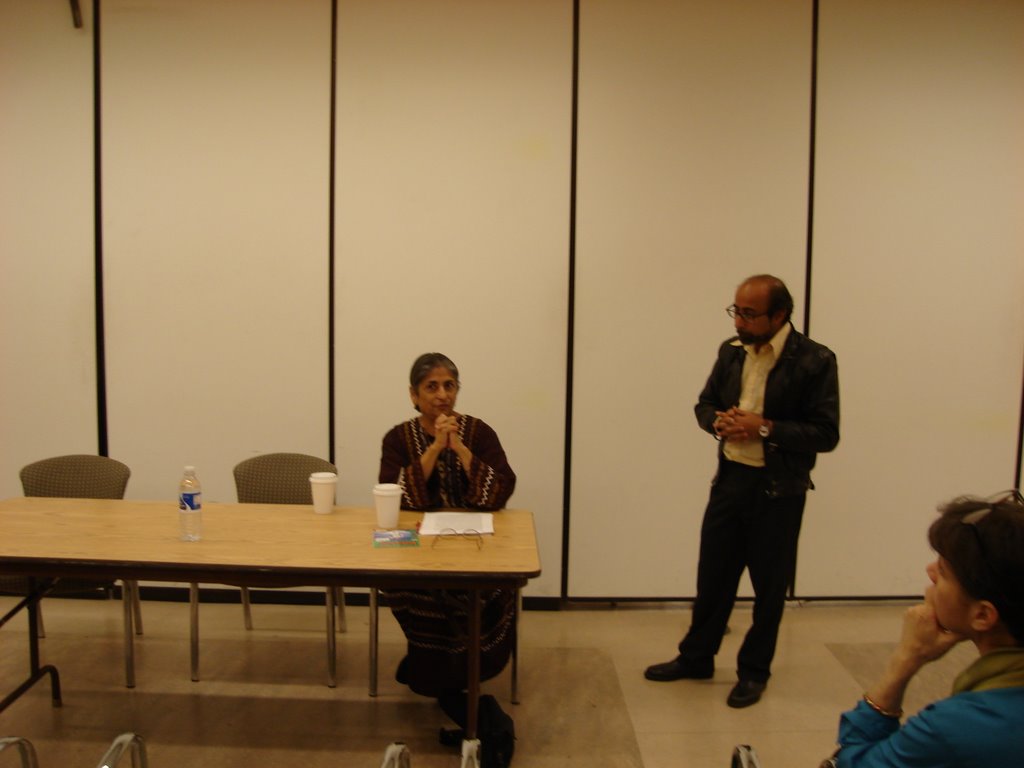
San Francisco Library’s Second Annual South Asian Writers Reading Event held at SF Public Library on Saturday, November 4
Roshni Rustomji-Kerns and another writer read their short stories. Rustomji’s story was titled “South going woman, north going woman.” Rhoda Sohrabji, the protagonist, grows up in the US, where she was transplanted from India when she was four; she now lives in Oaxaca where one day she gets involved with a network of people sympathetic to Oaxaca’s indigenous uprising; Rhoda gets to listen to stories of communal riots in India and ethnic strife in San Francisco. “South going woman, north going woman” appeared partly autobiographical--the only question being if Rustomji really took that dangerous ride in Oaxaca’s mountains to give safe company to a rebel. With the latest bout of political upheaval in Oaxaca—Mexico still struggling with its identity and notions of equality and justice, five centuries after the arrival of Conquistadores—Roshni Rustomji’s piece was timely and pertinent. It had humor sprinkled in good amount too. “If my kind of Indios aren’t allowed to rule Mexico, then your kind of Indios can rule Mexico.”
The other writer read English translation of his Urdu story. The translation was done by Moazzam Sheikh, widely known for his translation of Intizar Hussain and other Urdu writers’ work.
Most people in the audience were themselves writers, a self-supported community (members satisfying each other’s desire to be heard)—strong testimony to declining popularity of fiction writing as an art form. Why read or be read to when you can watch a movie?
(Picture shows Roshni Rustomji-Kerns and Moazzam Sheikh)
Saturday, November 04, 2006
Sharing a planet and an epoch
It was a chance meeting. I ran into him more than a year after we met last. But that short meeting brought back fond memories.
Save for my parents few people have done as much for me as he has. And knowing his boundless benevolence I am sure I am not the only recipient of his kindness.
“In the vastness of space” wrote Carl Sagan, “and the immensity of time it is my joy to share a planet and an epoch with Annie.” The reference was to his wife Ann Druyan. How true! Look at the history and the millennia to come and then look at the countless stars and imagine their planetary systems and lives that might be. How easy it is to miss a kind person by a few hundred years, by a few solar systems!
It indeed is my joy to share a planet and an epoch with Safwan Shah.
It was a chance meeting. I ran into him more than a year after we met last. But that short meeting brought back fond memories.
Save for my parents few people have done as much for me as he has. And knowing his boundless benevolence I am sure I am not the only recipient of his kindness.
“In the vastness of space” wrote Carl Sagan, “and the immensity of time it is my joy to share a planet and an epoch with Annie.” The reference was to his wife Ann Druyan. How true! Look at the history and the millennia to come and then look at the countless stars and imagine their planetary systems and lives that might be. How easy it is to miss a kind person by a few hundred years, by a few solar systems!
It indeed is my joy to share a planet and an epoch with Safwan Shah.
Sunday, October 29, 2006
Subscribe to:
Posts (Atom)
